
Has AI killed collaboration?
Last week, I sat in a conference room in Lisbon for a week of learning and collaboration. It turns out, my team is a bunch of very individual contributors who rarely have a need for collaboration, and the advent of AI into our daily work has made the need even less. This got me thinking about the impact of AI on that very essential skill. Have we lost even more human interaction opportunities?
Perhaps, in using AI for everything, we will lose the ability to collaborate, which in turn may destroy what is left of our interpersonal communication skills?
The death of the “Stupid Question”
When I was an employee of Microsoft, I opted to go into the office. I didn’t need to - my entire team was remote. My boss was in Austin, and co-workers were far-flung, from India to New York City. However, the office was still a hive of industry. I bumped into people at lunch. I had conversations with some of the best and brightest software engineers and product specialists on the planet. The lunchtime conversation improved my work measurably.
In a healthy collaborative environment, people bounce half-baked ideas off each other. You walk over to a coworker’s desk or ping them to ask a “stupid question”. That turns into a half hour exploring a topic you knew little about at the beginning. During that process, you have an idea that itself turns into a thing.
That is now gone. People ask AI first, avoiding the vulnerability associated with asking the question in the first place. While this feels efficient, it turns collaborative interactions into a sterile, instantaneous answer machine.
The death of Interpersonal Compromise
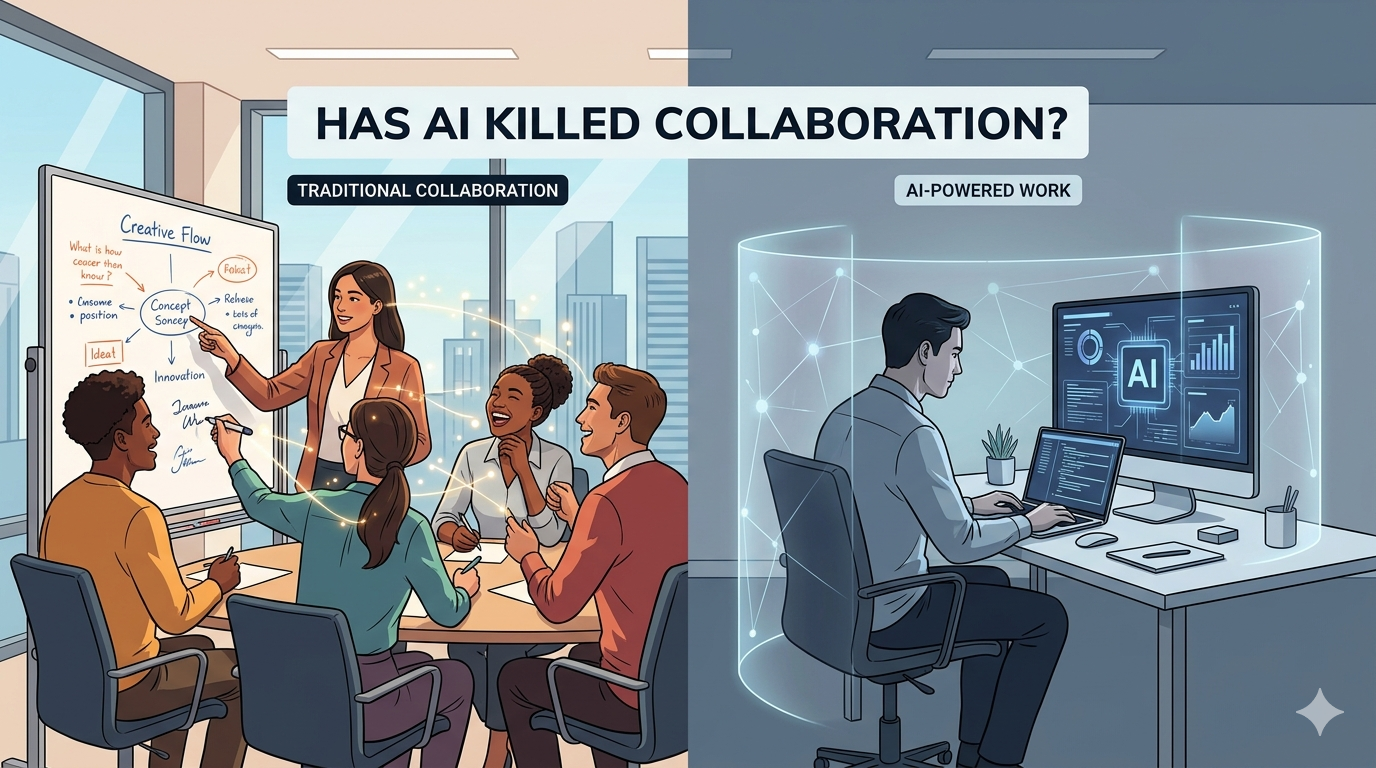
Some of my most memorable exchanges have been very long-winded debates. It wasn’t about one person having the right answer and the other person being wrong. It was about what each person brought to the table. Getting two or three people in front of a whiteboard highlights alternative ideas or problems that haven’t been considered. Each person’s experience has a multiplier effect on the outcome.
Collaboration isn’t just about getting an answer; it’s about empathy, negotiation, and dealing with conflicting viewpoints. You have to tune your communication to account for their experience, ego, tone, and perspective. In doing so, you get to a better result than before. Clarity is enjoyed; projects are approved; designs are better.
When every AI interaction is an echo chamber feeding your ego, the muscle for human compromise will surely atrophy.
The inevitability of Remote Work
Several major tech and finance firms have paired aggressive return-to-office mandates with massive AI rollouts. This creates a tension: while executives argue that physical presence is required for “culture and apprenticeship”, they are simultaneously deploying tools designed to automate the very interactions that traditionally happen in person. Examples include JPMorgan Chase, Meta, Microsoft, Salesforce, Google, and Amazon.
In March 2025, CEO Jamie Dimon mandated a 5-day in-office week for roughly 300,000 employees while simultaneously rolling out “LLM Suite”, an internal AI platform now used by over 230,000 employees. LLM Suite is specifically marketed to save 3-6 hours per week by automating client presentations, earnings analysis, and document synthesis - tasks that previously required significant team coordination.
If the majority of my work is with an AI prompt, doesn’t that make it easier to work asynchronously? Organizations are also requiring AI usage as a lever to increase productivity, yet research has shown that employees are just as or more productive when working remotely.
AI acts as an isolation chamber, making the worker a self-contained unit, bypassing the traditional team dynamic entirely.
Savings are not reinvested
I’m sure the ardent defenders of AI will argue that automating the tedious, transactional work brings benefits. AI frees up more time for high-value human connection, or so the argument goes.
My experience so far has been that I no longer take notes at meetings and I write code faster. However, the time saved isn’t reinvested in human connection. Instead, I’m just more productive as an individual contributor.
Final thoughts
When mobile phones came about, the change in behaviors wasn’t apparent early on. Look around a typical restaurant or bar these days - you find a majority of people with their noses in their phones. This is a clear effect of the impact - technology moves on and we isolate from others in our immediate sphere.
AI isn’t good or bad in itself - how we use it is the key. Unfortunately, the easy path will be more isolation and less social skills for young and old alike.
The hard path requires conscious and continual effort. It means leaving AI for the transactional and research tasks where efficiency matters, while deliberately setting it aside for the work that depends on human interaction to be most effective. Without this effort, I see AI as accelerating the trend we already see with mobile phones - more isolation, less interaction, and a less empathetic population.
When I was in Lisbon, the expectation was to use AI even though we were in the same room. We opted to use the time for collaboration. The process takes longer. Ultimately, the result is better understood and better suited to the intended purpose.
Leave a comment