
Are we in an AI bubble or an AI revolution?
I read a lot on the Internet from the prognosticators about whether AI is terrible or awesome - are we in a bubble or a revolution in the way we work?
Why not both?
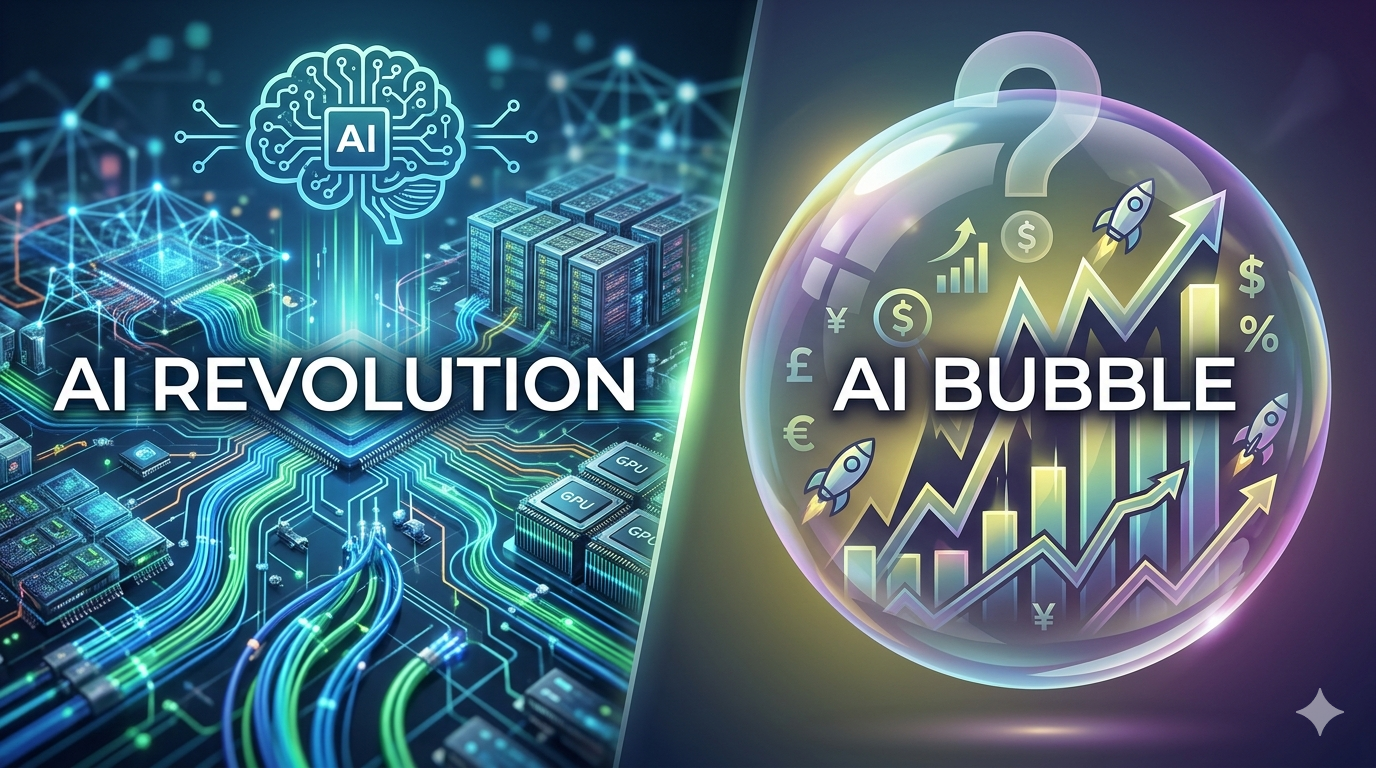
Perhaps the best way to explain this is by - as everyone else is - drawing parallels to the other bubble / revolution that we all experienced - the dot-com crash of 2000. The year 2000 represents the moment where the financial excitement (the bubble) outpaced the actual infrastructure (the revolution).
The Bubble: Financial euphoria & irrational exuberance
The “bubble” aspect was driven by a disconnect between stock prices and business fundamentals. In 2000, investors were terrified of missing out on the new economy. Simply adding “.com” to a company name could double its stock price overnight, regardless of whether a company had a path to profitability.
Companies like pets.com and Webvan spent millions on Super Bowl ads and massive warehouses before they had a stable customer base. Success was measured in “clicks” rather than cash flow. Between 1995 and 2000, the NASDAQ composite spiked 800%.
When the fed raised interest rates and capital dried up, the index crashed by 78% wiping out $5 trillion in market value. The bubble burst.
The Revolution: The silent laying of the infrastructure
While the stock market was collapsing, the “revolution” was quietly succeeding. The bubble provided the capital necessary to build the world we live in now.
During the boom, companies laid thousands of miles of fiber-optic cable. When they went bankrupt, the dark fiber remained in the ground, making high-speed internet incredibly cheap and accessible for the next generation of startups (like YouTube and Netflix).
The late 90s saw the birth of Amazon (1994) and Google (1998). While their stocks definitely took a hit in 2000, their underlying technologies - scalable e-commerce and algorithmic search - were fundamentally sound. More importantly, they had already moved on from clicks to cash flow.
The revolution wasn’t just code; it was a shift in human psychology. By 2000, the idea of buying a book online or sending an email had moved from “fringe” to “inevitable”.
The AI parallel
The similarities are striking:
- In 2000, there was massive VC funding with no revenue models. Today, billions are poured into LLM startups with massive compute cost and no sustainable plan on monetization.
- In 2000, the big infrastructure play was fiber-optic cables and early servers. Todays companies are building out GPU clusters and massive data centers.
- In 2000, the play was to sell whatever the idea was on the web instead of bricks and mortar stored. Today, we are putting “AI” into every toaster, refridgerator, and toothbrush.
- In 2000, there was a shift from physical to digitial information and commerce. Today, there is a shift from manual creation to generative intelligence.
Final thoughts
In 2000, the “Internet” was right, but many “Internet companies” were wrong. The revolution survived the bubble because the utility of the technology was real, even if the valuations of the companies providing it were a fantasy.
Today, “AI” is right, but many of todays products and companies will fail because AI is being shoe-horned into products that don’t need it. Just like in 2000, don’t expect the early companies to be the ones that win the day. I don’t expect OpenAI or Anthropic to survive in their current form. The cash burn is too large for the monetization event.
What will survive? I suspect the infrastructure - the GPU clusters needed to drive AI - will still be needed, so expect the hyperscalers to come out - not unscathed - but with the facilities to really take advantage. You can also bet that the underlying utility plays will do ok. Think the comment system that automatically regulates itself, or the fraud scanners that are suddenly better at their job.
What will emerge will affect every single industry. And how we do work will have changed forever.
AI Disclosure
All my blogs are written by hand. The images are produced using Google Gemini.
Leave a comment